 Español
Taking a road test in New York can be an anxiety-inducing experience for new drivers. Many candidates focus solely on technical driving skills while overlooking crucial aspects that examiners are specifically trained to observe. This comprehensive guide draws on insights from former New York road test officials to reveal what examiners are really looking for during those nerve-wracking 15-20 minutes that determine whether you'll earn your driver's license.
Understanding the examiner's perspective can dramatically improve your chances of success. These officials aren't trying to fail candidates—they're ensuring that only safe, responsible drivers earn the privilege of driving independently on New York's busy roads.
The Examiner's Mindset
The Primary Mission: Safety First
According to former NY road test examiner Michael Rodriguez, who conducted over 15,000 road tests during his 12-year career, "Our job isn't to catch you making mistakes—it's to determine if you can safely operate a vehicle in various traffic conditions without supervision."
Road test examiners are trained to evaluate drivers through a safety-focused lens. Their primary concern isn't whether you perform a textbook parallel park, but whether you consistently demonstrate awareness of your surroundings and make decisions that prioritize safety.
Beyond the Checklist
While examiners do use a standardized scoring sheet, former examiner Sarah Johnson notes, "We're looking at the complete picture of how you drive. Sometimes a candidate can make several minor errors but pass because they demonstrate good judgment and awareness throughout the test. Conversely, a single serious safety lapse can result in an automatic failure."
This holistic approach means examiners are constantly assessing your:
- Situational awareness
- Decision-making process
- Ability to anticipate potential hazards
- Overall confidence and control
Critical Skills That Make or Break Your Road Test
Observation Techniques: The "Head on a Swivel"
What Examiners Notice About Your Observation
Former examiner Thomas Chen explains, "I can tell within the first two minutes if a candidate is properly scanning their environment. Many drivers fail simply because they aren't looking around enough."
Examiners are specifically watching for:
- Mirror checks: Frequency and timing
- Blind spot checks: Proper head turns before lane changes
- Intersection scanning: Looking left-right-left before proceeding
- Forward focus: Maintaining appropriate forward vision while still checking surroundings
Red Flags in Driver Observation
Examiners immediately note when candidates:
- Fixate too long on any one area
- Fail to check mirrors before slowing down
- Make lane changes without head checks
- Focus exclusively on the car ahead without scanning the broader environment
Speed Management: Consistency is Key
Former examiner Patricia Alvarez shares, "Many drivers think driving slower is safer, but inconsistent speed creates hazards. I'm looking for appropriate speed for conditions and smooth, predictable changes in velocity."
Examiners are trained to evaluate:
- Speed appropriateness: Driving at or slightly below the speed limit when conditions permit
- Speed consistency: Maintaining steady speeds without unnecessary fluctuations
- Speed adjustments: Smooth deceleration for turns, traffic, and hazards
- Context awareness: Adjusting speed based on environmental factors (school zones, weather conditions, etc.)
Communication With Other Road Users
"Proper signaling isn't just about following rules—it's about clearly communicating your intentions to everyone around you," says former examiner William Jackson.
Examiners evaluate:
- Signal timing: Using turn signals sufficiently in advance (100 feet before turns, lane changes)
- Signal consistency: Using signals for all turns and lane changes, no exceptions
- Horn usage: Appropriate use of horn for safety (rarely needed during tests)
- Light usage: Proper use of headlights, especially during adverse conditions
Need a Car for Your Road Test?
We bring a DMV-ready vehicle to your test site and give you a warm-up drive before the examiner gets in. Tell us your appointment time and we handle the rest.
📞 +1 (929) 243-9547Mon-Sat: 9 AM - 7 PM
Automatic Failure Points: What Former Examiners Reveal
Dangerous Maneuvers
Former examiner David Kim is straightforward: "Some mistakes immediately end the test because they demonstrate a fundamental safety issue."
|
Automatic Failure Actions |
Why Examiners Fail You Immediately |
|
Rolling through stop signs |
Demonstrates disregard for traffic control devices and potential failure to yield |
|
Speeding (10+ mph over limit) |
Shows inability to control vehicle speed and follow basic traffic laws |
|
Crossing solid lines |
Indicates lack of understanding of basic road markings |
|
Hitting curbs during turns |
Demonstrates poor spatial awareness and vehicle control |
|
Following too closely |
Shows dangerous judgment and creates unnecessary risk |
|
Cutting off other vehicles |
Demonstrates poor judgment and creates dangerous situations |
|
Driving in bike lanes |
Shows disregard for protected spaces and endangers vulnerable road users |
Examiner Interventions
"If I have to physically or verbally intervene during a test, it's an automatic failure," explains former examiner Lisa Thompson. "This includes grabbing the wheel, telling you to stop, or giving emergency instructions."
Interventions that result in immediate failure include:
- Verbal commands to stop or change direction to avoid collision
- Physical contact with the steering wheel or controls
- Instructing the driver to pull over because of unsafe behavior
The Four Phases of the Road Test: What Examiners Evaluate
Phase 1: Pre-Driving Assessment
Your First Impression Matters
"I start evaluating candidates before the car even moves," reveals former examiner Robert Martinez. "How they approach the vehicle, adjust their seat, check mirrors—it all indicates their level of preparation and familiarity with the vehicle."
Examiners are noting:
- Vehicle familiarity: Confidence in adjusting controls and preparing the vehicle
- Pre-drive checks: Mirror adjustments, seat positioning, seatbelt use
- Initial awareness: Checking surroundings before putting the car in motion
- Starting procedure: Smooth, controlled vehicle startup
The Critical First Minute
This initial phase sets the tone for the entire test. Candidates who appear flustered or unfamiliar with basic controls create immediate concern for examiners.
Phase 2: Basic Control Evaluation
During the first few minutes of actual driving, examiners are establishing your baseline competency.
"In the first block or two, I'm determining if you have the basic control skills needed to safely operate the vehicle," says former examiner Jennifer Wong. "If you're struggling with fundamentals like maintaining your lane position or using appropriate speed, I'm immediately more vigilant."
Examiners focus on:
- Steering control: Smooth, controlled steering with proper hand positioning
- Lane positioning: Maintaining appropriate position without weaving or drifting
- Speed control: Ability to maintain consistent, appropriate speed
- Basic turns: Execution of fundamental right and left turns
Phase 3: Special Maneuvers
The Purpose Behind Required Maneuvers
Former examiner James Wilson explains, "Each special maneuver tests specific skills. Parallel parking isn't just about parking—it's about precise control, spatial awareness, and multi-tasking."
|
Maneuver |
Primary Skills Evaluated |
What Examiners Really Look For |
|
Parallel Parking |
Spatial awareness, precision |
Not perfection, but controlled execution and safety awareness |
|
Three-Point Turn |
Control in tight spaces, awareness |
Complete observation before and during the maneuver |
|
Backing Up |
Reverse control, observation |
Head turns, not just mirror usage |
|
Hill Parking |
Technical knowledge, vehicle control |
Understanding of proper wheel positioning and brake/gear usage |
Common Misconceptions About Special Maneuvers
"A perfect parallel park with no observation checks is worse than an imperfect park with excellent awareness," notes former examiner Nancy Taylor. "Many candidates focus too much on the technical execution and forget to keep checking their surroundings."
Phase 4: Traffic Integration
The final and most crucial phase evaluates how well you integrate with actual traffic conditions.
Former examiner Carlos Diaz emphasizes, "This is where I determine if you're ready for independent driving. Can you safely navigate complex traffic situations while maintaining awareness and making good decisions?"
Examiners are evaluating:
- Traffic flow integration: Ability to merge and maintain appropriate spacing
- Right-of-way decisions: Proper yielding and assertion of right-of-way
- Intersection navigation: Safe and legal navigation of various intersection types
- Adaptability: Response to changing road and traffic conditions
The Subtleties Examiners Notice That Most Candidates Miss
Body Language and Non-Verbal Cues
"I watch a driver's body language closely," says former examiner Elizabeth Brown. "Tension in the shoulders, white knuckles on the wheel, or constant glances at the examiner rather than the road all indicate anxiety levels that might affect decision-making."
Examiners are trained to notice:
- Comfort level: Physical signs of extreme nervousness vs. controlled focus
- Confidence signals: Posture, grip tension, eye movement patterns
- Reaction to feedback: How candidates respond to instructions or corrections
- Consistency: Changes in behavior throughout the test
Recovery From Mistakes
Former examiner George Washington (no relation to the president) shares an important insight: "How a driver recovers from a mistake often matters more than the mistake itself. Do they get flustered and make additional errors, or do they acknowledge the issue and continue safely?"
Examiners particularly note:
- Composure maintenance: Ability to stay calm after minor errors
- Correction approach: Safe, controlled corrections rather than jerky reactions
- Focus retention: Maintaining awareness even when something goes wrong
- Adaptation: Learning from a mistake and not repeating it
Proactive vs. Reactive Driving
"The best candidates drive proactively, not reactively," explains former examiner Michelle Park. "They anticipate potential issues before they develop rather than merely responding to immediate dangers."
Signs of proactive driving that impress examiners:
- Speed adjustments: Slowing appropriately before reaching congestion
- Lane positioning: Moving to appropriate lanes well in advance of turns
- Hazard anticipation: Noticing and preparing for potential problems (children near the road, vehicles showing signs of potential turns)
- Gap selection: Choosing appropriate gaps in traffic that don't require other drivers to adjust their speed
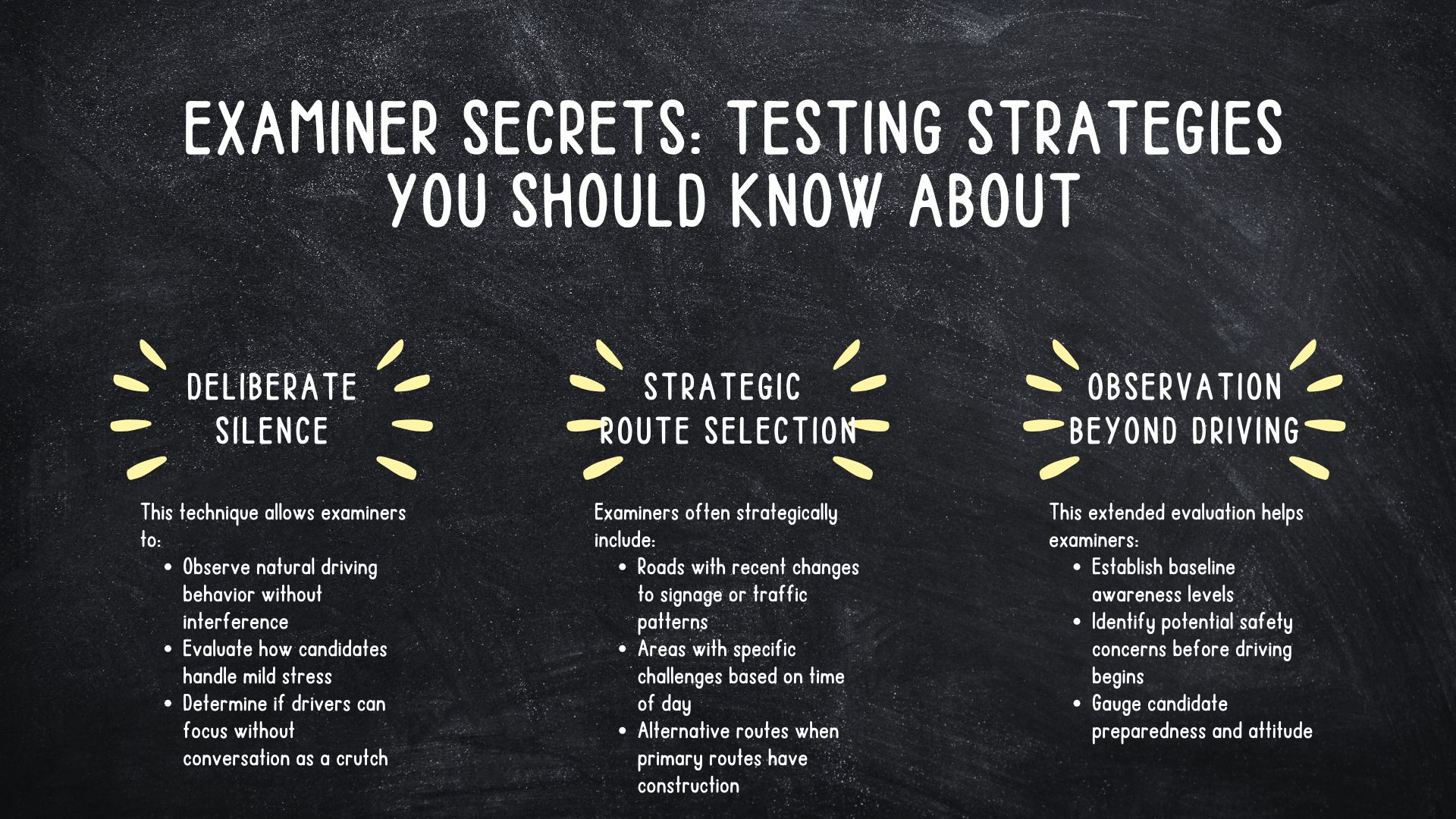
Examiner Secrets: Testing Strategies You Should Know About
Deliberate Silence
"The silence in the car is intentional," reveals former examiner Daniel Garcia. "We're trained to limit conversation to necessary instructions. This creates a space where the candidate's natural driving habits emerge without distraction or coaching."
This technique allows examiners to:
- Observe natural driving behavior without interference
- Evaluate how candidates handle mild stress
- Determine if drivers can focus without conversation as a crutch
Strategic Route Selection
Former examiner Olivia Robinson explains, "While there are standard routes, examiners have flexibility in choosing specific streets based on traffic conditions and what we need to evaluate for a particular candidate."
Examiners often strategically include:
- Roads with recent changes to signage or traffic patterns
- Areas with specific challenges based on time of day
- Alternative routes when primary routes have construction or unusual conditions
Observation Beyond Driving
"I'm evaluating you from the moment we meet," says former examiner Richard Taylor. "How you approach the test vehicle, your awareness while walking to the car, and even how you respond to initial instructions all factor into my assessment."
This extended evaluation helps examiners:
- Establish baseline awareness levels
- Identify potential safety concerns before driving begins
- Gauge candidate preparedness and attitude
Preparing Like an Insider: Former Examiners' Advice
The Week Before Your Test
Former examiner Kelly Martinez advises, "The week before your test, practice driving at the same time of day as your appointment. Traffic and light conditions matter, and you want to be prepared for the specific challenges of that time."
Additional preparation tips:
- Route familiarity: Practice on known testing routes in your area
- Condition adaptation: Drive in various weather conditions (if safe)
- Independent driving: Practice without instructor guidance to build autonomy
- Stress simulation: Have someone silently evaluate your driving to simulate test conditions
The Day of Your Test
"On test day, arrive early but not too early," suggests former examiner Brian Williams. "Arriving 15-20 minutes before gives you time to compose yourself without prolonged waiting that builds anxiety."
Former examiners recommend:
- Vehicle check: Ensure all signals, lights, and controls are functioning properly
- Mental preparation: Use visualization techniques to imagine successful test completion
- Physical readiness: Be well-rested and avoid excessive caffeine
- Documentation organization: Have all required documents readily accessible
During the Test: Mental Strategies
"Talk yourself through procedures if it helps," says former examiner Angela Smith. "Many examiners won't mind if you verbalize your process like 'checking mirrors, signaling, checking blind spot' as long as you're actually performing these actions correctly."
Other mental strategies recommended by former examiners:
- Compartmentalization: Treat each segment of the test as a separate challenge
- Reset technique: If you make a mistake, take a deep breath and mentally reset
- Focus narrowing: Concentrate only on current task requirements, not the entire test
- Self-instruction: Use internal reminders of key procedures
Conclusion: The Examiner's Perspective on Success
Former examiners unanimously agree that road test success comes down to demonstrating that you can be trusted to drive safely without supervision. Technical perfection matters less than consistent safety awareness and good judgment.
As former examiner David Williams summarizes, "At the end of the test, I ask myself one question: Would I feel comfortable with my family member in a car with this driver? If the answer is yes, they've passed, regardless of minor imperfections."
By understanding what road test examiners are truly evaluating, you can approach your test with greater confidence and focus on the aspects that matter most. Remember that these officials aren't looking to fail you—they're ensuring that everyone who passes has demonstrated the skills and awareness necessary to join the community of safe, responsible drivers on New York's roads.
Need a Car for Your Road Test?
We bring a DMV-ready vehicle to your test site and give you a warm-up drive before the examiner gets in. Tell us your appointment time and we handle the rest.
📞 +1 (929) 243-9547Mon-Sat: 9 AM - 7 PM
FAQ
-
How long does a typical New York road test last?
A standard New York road test typically lasts between 15-20 minutes, though this can vary slightly depending on traffic conditions and the specific testing location. The examiner needs just this short time to effectively evaluate your driving abilities and safety awareness.
-
What is the current pass rate for New York road tests?
According to recent data, the statewide pass rate for first-time road test takers in New York is approximately 60%. This rate varies significantly by location, with some testing sites in dense urban areas like parts of Brooklyn and Queens having pass rates closer to 40%, while some suburban and upstate locations see rates as high as 70%.
-
Can I use my driving school's vehicle for the road test?
Yes, you can use a driving school vehicle for your road test, and many candidates choose this option. Driving schools ensure their vehicles meet all testing requirements and often provide a brief pre-test lesson to help you prepare. Some examiners note that using a familiar driving school vehicle can help reduce test anxiety.
-
What documentation do I need to bring to my road test?
For your road test in New York, you must bring your learner permit, a completed MV-262 form (road test application), and your pre-licensing course completion certificate (MV-278). Additionally, you'll need to arrive with a supervising licensed driver who is at least 21 years old with a valid license. Make sure your vehicle is in proper working condition with current registration and insurance documentation accessible for the examiner to verify if requested.
-
Do I need to schedule a road test appointment in advance?
Yes, all New York road tests require scheduling in advance through the DMV's online scheduling system or by phone. Walk-in testing is not available. Appointments can often be booked 2-3 months in advance, so plan accordingly.
-
What is the single biggest reason people fail their road test in New York?
According to former examiners, the single most common reason for failure is inadequate observation-specifically, failing to check mirrors and blind spots consistently before changing lanes or making turns. This fundamental safety issue signals to examiners that a driver isn't maintaining proper awareness of their surroundings.
-
Do examiners have a quota of failures they need to meet?
No, this is a common misconception. Former examiners unanimously confirm there are no quotas for passing or failing candidates. Examiners are evaluated on their accuracy and consistency in applying testing standards, not on how many people they pass or fail.